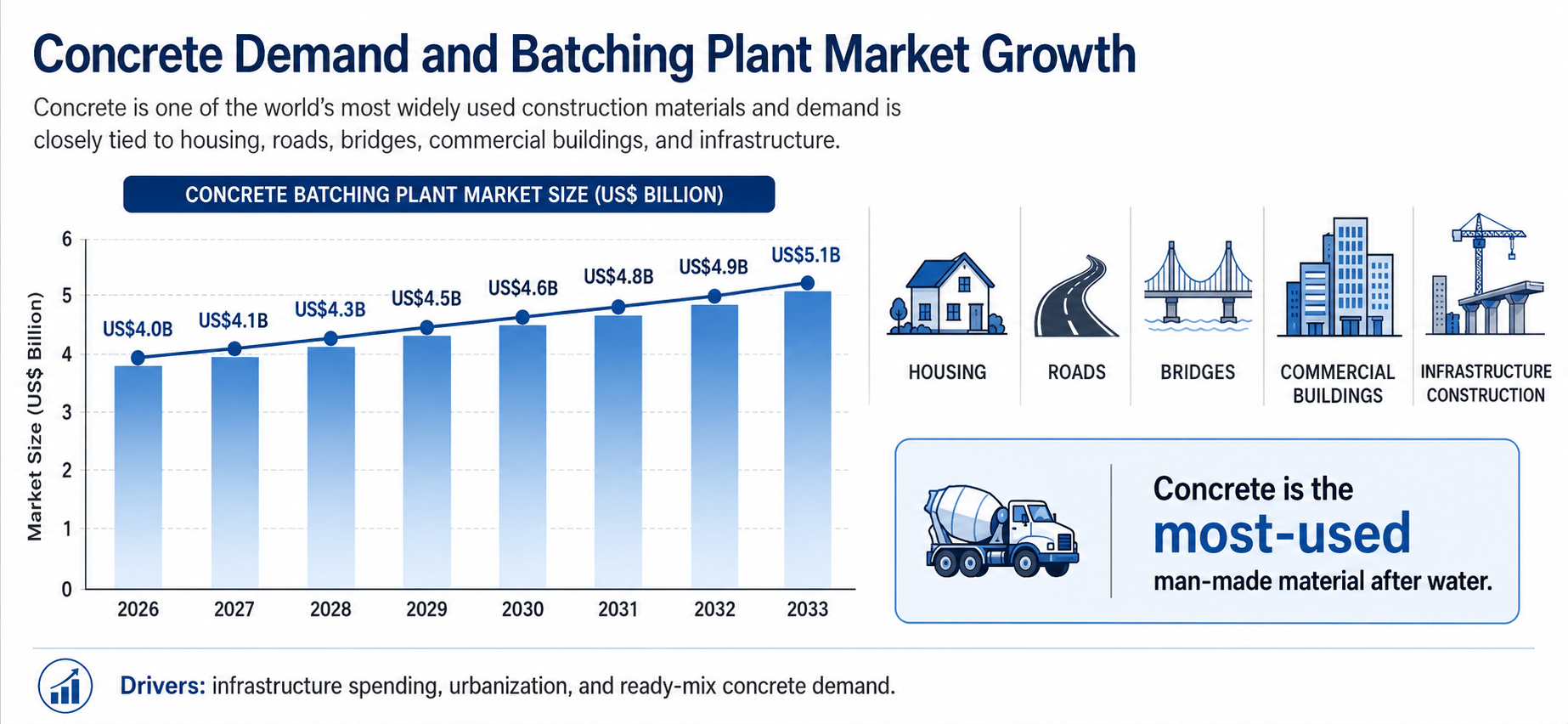
Concrete remains one of the world’s most widely used construction materials. The Global Cement and Concrete Association describes concrete as the most-used man-made material after water, and global concrete use is closely tied to housing, roads, bridges, commercial buildings, and infrastructure construction. The concrete batching plant market is also projected to grow from about US$4.0 billion in 2026 to US$5.1 billion by 2033, driven by infrastructure spending, urbanization, and ready-mix concrete demand.
What Does Concrete Batching Plant Capacity Mean?
Concrete batching plant capacity usually refers to the rated output under standard production conditions. For example, a 50 m³/h concrete batching plant is designed to produce up to 50 cubic meters of concrete per hour when aggregate feeding, cement supply, mixer cycle, water dosing, admixture dosing, discharge, and truck coordination work smoothly.
However, rated capacity is not always the same as actual site output. In real operation, production may be affected by:
- aggregate moisture content;
- cement silo and screw conveyor feeding speed;
- mixer loading and discharge cycle;
- concrete mix design;
- truck waiting time;
- site layout;
- power stability;
- operator experience;
- cleaning, maintenance, and shift arrangement.
Some industry selection guides recommend calculating capacity from peak daily demand divided by planned working hours, then adding a buffer for real-site conditions. One recent equipment guide gives the example of 500 m³ per day across 8 hours, which requires at least 62.5 m³/h before considering a capacity buffer.
Industry Research Snapshot: Why Capacity Planning Matters
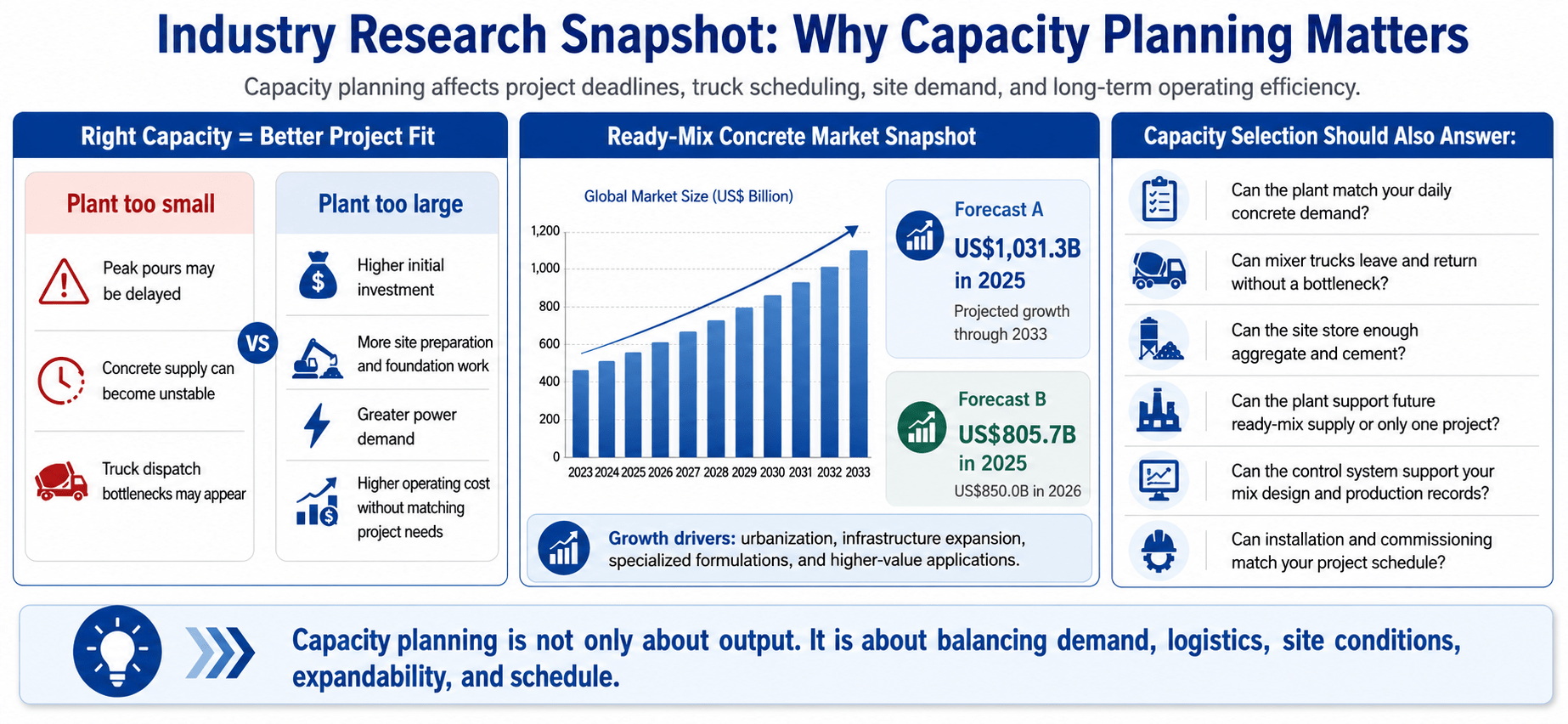
Capacity planning matters because concrete production is usually connected to project deadlines, truck scheduling, and continuous site demand. A plant that is too small can delay concrete supply during peak pouring. A plant that is too large may increase investment, site preparation, foundation work, power demand, and operating cost without improving actual project efficiency.
The ready-mix concrete market is also expanding globally. One market forecast estimates the global ready-mix concrete market at about US$1,031.3 billion in 2025, with projected growth through 2033, supported by urbanization and infrastructure expansion. Another forecast estimates the market at US$805.7 billion in 2025 and US$850.0 billion in 2026, with growth driven by specialized formulations and higher-value applications.
For buyers, this means capacity selection should not only answer “How much concrete can the plant produce?” It should also answer:
- Can the plant match your daily concrete demand?
- Can mixer trucks leave and return without creating a bottleneck?
- Can the site store enough aggregate and cement?
- Can the plant support future ready-mix supply or only one project?
- Can the control system support your mix design and production records?
- Can installation and commissioning match your project schedule?
Quick Capacity Selection Table
The table below gives a practical starting point for capacity selection. Final configuration should still be checked based on your project type, country, working hours, site layout, and material supply conditions.
| Project Type | Suggested Capacity | Suitable Plant Direction |
|---|---|---|
| Rural housing, small building, small township road, contractor self-use | 25–35 m³/h | HZS25, HZS35, YHZS25 |
| Medium building, road drainage, small bridge, small ready-mix supply | 50–60 m³/h | HZS50, HZS60, YHZS50, MHZS60 |
| Regional contractor, commercial building, precast yard, stable daily demand | 75–90 m³/h | HZS75, HZS90, MHZS90 |
| Ready-mix concrete supply, urban construction, large building cluster | 120 m³/h | HZS120, MHZS120 |
| Highway, bridge, airport, dam, industrial park, high-volume ready-mix operation | 180–240 m³/h | Large stationary batching plant or twin-line system |
This table should be used as an initial guide. For example, a 50 m³/h plant may be enough for a contractor’s own project, but a ready-mix supplier serving several jobsites may need 90–120 m³/h to handle peak demand.
How to Estimate the Required Capacity
A simple calculation can help you estimate your required plant capacity:
Recommended rated capacity = Daily concrete demand ÷ Effective working hours × 1.2–1.4 safety factor
For example:
If your project needs 400 m3 of concrete per day and the plant can operate for 8 effective hours, the basic hourly requirement is:
400 ÷ 8 = 50 m3/h
However, your plant may not work at full rated output all day. Truck waiting, material feeding, mix changes, cleaning, and dispatch intervals can reduce real production efficiency. After adding a 20–40% safety factor, a 60 m3/h plant may be more suitable than a 50 m3/h plant.
Another equipment selection guide also uses daily demand and effective working hours as the basis for capacity calculation and adds a safety buffer to avoid production delays during peak pouring periods.
This calculation is especially useful when your project has a clear daily concrete target. It also helps avoid two common mistakes:
- Choosing the smallest plant only because the initial price is lower.
- Choosing an oversized plant without enough truck, aggregate, cement, or site support.
25–35 m3/h Concrete Batching Plant: Small Projects and Contractor Self-Use
A 25–35 m3/h concrete batching plant is usually suitable for small construction projects, rural housing, township roads, small precast yards, and contractors who need concrete for their own jobsites. This capacity range is often selected when daily concrete demand is limited, the project schedule is flexible, and the buyer wants to control initial investment.
Typical applications include:
- rural house building;
- small road repair;
- local drainage works;
- small bridge or culvert construction;
- small precast component production;
- first-time concrete plant investment.
A 25–35 m3/h plant can be configured as a stationary plant or a mobile plant, depending on whether your project stays in one location or needs relocation. For fixed production, HZS25 or HZS35 can be considered. For temporary jobsites, YHZS25 or YHZS35 may help reduce repeated installation work.
At this capacity level, your project should pay attention to mixer size, aggregate bin arrangement, cement silo selection, and whether the plant will only serve one site or several nearby sites. If the plant needs to supply concrete to multiple locations, truck cycle time becomes more important.

50–60 m3/h Concrete Batching Plant: Medium Contractors and Road Projects
A 50–60 m3/h concrete batching plant is a common choice for medium contractors, road projects, building construction, and small ready-mix supply. It provides higher output than entry-level plants while keeping site layout and investment manageable.
This capacity range is often suitable when your project needs 300–450 m3 of concrete per day, depending on effective working hours and delivery conditions. It can support building foundations, road structures, bridge substructures, commercial construction, and contractor-owned concrete production.
Compared with 25–35 m3/h plants, a 50–60 m3/h plant usually needs more careful planning for:
- aggregate storage;
- cement silo capacity;
- screw conveyor feeding;
- mixer truck loading area;
- power supply;
- control room position;
- operator visibility and truck route.
A 50–60 m3/h stationary plant can be suitable for a fixed production site. A 50 m3/h mobile concrete batching plant can be considered when your project needs relocation between road sections or temporary construction zones. A foundation-free concrete batching plant may also be considered when your site has limited time for civil foundation work.
75–90 m3/h Concrete Batching Plant: Regional Contractors and Stable Daily Demand
A 75–90 m3/h concrete batching plant is suitable for regional contractors, commercial building projects, precast component production, and ready-mix suppliers with stable daily orders. This capacity range requires stronger coordination between the batching plant, mixer trucks, aggregate supply, cement storage, and site dispatch.
At this level, capacity selection should not only consider the plant itself. Your project should also check whether:
- aggregate can be supplied continuously;
- cement silo capacity is enough for daily production;
- mixer trucks can return quickly enough;
- there is enough space for truck waiting and loading;
- different concrete grades need frequent mix changes;
- the site has suitable power capacity;
- the control system can manage stable production records.
If mixer trucks spend too much time waiting on road sections or at jobsites, even a high-capacity plant may not reach its expected output. For this reason, 75–90 m3/h plants are often selected by buyers who already have a stable project pipeline or ready-mix customer base.

120 m3/h Concrete Batching Plant: Ready-Mix and Continuous Concrete Supply
A 120 m3/h concrete batching plant is often used for commercial ready-mix concrete production, large building clusters, infrastructure construction, and long-term concrete supply. Compared with small and medium plants, this capacity level needs more complete planning for aggregate storage, cement silo quantity, belt conveyor feeding, truck loading, electrical supply, and control system management.
A 120 m3/h plant may be suitable when your project has:
- continuous daily concrete demand;
- several mixer trucks operating at the same time;
- nearby construction sites to supply;
- stable cement and aggregate sources;
- enough land for material storage and truck movement;
- a long-term production plan.
For ready-mix suppliers, this capacity range can help handle peak orders more effectively than a small plant. However, it also requires a stronger supporting system. The plant layout should allow trucks to enter, load, and leave without blocking aggregate feeding or cement delivery.
Before choosing a 120 m3/h plant, your project should confirm daily concrete demand, peak-hour delivery requirement, mixer truck quantity, working shifts, cement silo plan, and whether future expansion is needed.
180–240 m3/h Concrete Batching Plant: Large Infrastructure and High-Volume Production
A 180–240 m3/h concrete batching plant is usually considered for large infrastructure, airport, bridge, dam, highway, industrial park, or high-volume ready-mix concrete operations. At this capacity level, the plant is not just a single machine purchase. It becomes a complete production system.
Your project may need to evaluate:
- aggregate storage and feeding system;
- cement silo group;
- screw conveyor arrangement;
- admixture system;
- belt conveyor or bucket feeding method;
- batching accuracy;
- truck loading route;
- dust control;
- water supply and recycling;
- control system;
- installation plan;
- future maintenance access.
For some large projects, a twin-line system may be more practical than relying on one production line. A twin-line layout can help improve production flexibility, reduce risk during maintenance, and support different mix requirements.
For this capacity level, QIC Machinery usually recommends reviewing site layout, aggregate supply, cement storage, truck loading route, and local installation conditions before final configuration.

Key Factors That Affect Capacity Selection
1. Daily Concrete Demand
Your daily concrete demand is the first number to check. A project needing 150 m3 per day does not require the same plant as a project needing 1,000 m3 per day. If your daily demand changes sharply during peak periods, capacity should be selected based on peak demand rather than average demand only.
2. Effective Working Hours
A project may operate for 10 hours per day, but the plant may not produce continuously for all 10 hours. Material waiting, truck coordination, operator shifts, cleaning, inspection, and mix changes reduce effective production time. For capacity calculation, use realistic effective working hours.
3. Project Type
Housing, road construction, bridge work, commercial buildings, precast production, and ready-mix supply have different demand patterns. A contractor-owned plant may produce for one project. A ready-mix supplier may need to respond to several orders during the same day.
4. Mixer Truck Cycle Time
Mixer truck cycle time can become a major bottleneck. If trucks need a long time to reach the jobsite, discharge, return, and reload, the plant may wait even when its rated capacity is high. Capacity selection should be matched with truck quantity and delivery distance.
5. Concrete Mix Design
Different concrete grades, admixtures, slump requirements, and mixing times can affect output. A simple mix may be produced faster than a high-performance or special mix that needs longer mixing or more careful dosing.
6. Site Layout and Feeding Method
A compact site may limit aggregate storage, truck movement, and silo arrangement. Belt feeding is often used for medium and large plants because it supports continuous aggregate transfer. Skip hoist feeding can be suitable for compact layouts and smaller capacity ranges.
7. Future Expansion
Your current demand may be small, but your business plan may include future ready-mix supply, more contractors, or additional project sites. If expansion is likely, it is better to discuss layout and configuration early instead of choosing a plant that cannot support future growth.

Stationary, Mobile, or Foundation-Free: Which Plant Type Fits Your Capacity?
Capacity selection should be combined with plant type. The same rated output may fit different project conditions depending on whether your plant is fixed, movable, or designed for reduced foundation work.
| Plant Type | Suitable For | Common Capacity Range |
|---|---|---|
| Stationary concrete batching plant | Long-term fixed production, ready-mix supply, large projects | 25–240 m3/h |
| Mobile concrete batching plant | Temporary projects, road construction, relocation jobsites | 25–100 m3/h |
| Foundation-free concrete batching plant | Faster setup with reduced civil foundation work | 25–120 m3/h |
If your project will stay in one location for several years, a stationary concrete batching plant usually gives better layout flexibility and long-term production stability. If your project needs relocation between jobsites, a mobile concrete batching plant may reduce repeated installation work. If your site has limited time for foundation construction, a foundation-free batching plant can be considered after layout review.
The correct choice should be based on your project duration, relocation frequency, land condition, installation schedule, and future production plan.

What Information Should You Prepare Before Asking for a Quotation?
To recommend a suitable concrete batching plant capacity, QIC Machinery needs more than the model name. The more project information you provide, the more accurate the capacity and configuration recommendation can be.
| Information | Why It Matters |
|---|---|
| Country and project location | Affects shipping, voltage, installation plan, and local site conditions |
| Project type | Road, building, bridge, ready-mix, precast, or infrastructure |
| Daily concrete demand | Helps estimate required hourly capacity |
| Working hours per day | Helps calculate practical output |
| Concrete grade and mix design | Affects mixer cycle, dosing system, and production rhythm |
| Site size | Affects layout, aggregate storage, and truck route |
| Cement silo requirement | Affects powder storage and feeding efficiency |
| Relocation requirement | Helps choose stationary, mobile, or foundation-free plant |
| Future expansion plan | Helps avoid under-sized layout and limited configuration |
If you are not sure which capacity fits your project, prepare your daily concrete demand, working hours, project type, country, and site condition. QIC Machinery can help review your capacity range, plant type, basic configuration, and layout direction before quotation.
