Start with the Slowest Part of the Work Cycle
The slowest step controls how much concrete reaches the pour. Aggregate and cement loading, water measurement, mixing time, hopper transfer, pipeline resistance, cleaning, and repositioning all reduce the amount that can be placed during a shift.
For example, a pump rated at 40 m³/h cannot place 40 m³/h continuously if the mixer and feeding process supply only part of that amount. Increasing pump capacity without changing the slow step adds cost but does not remove the delay.
Use the shift target, not only the pump label
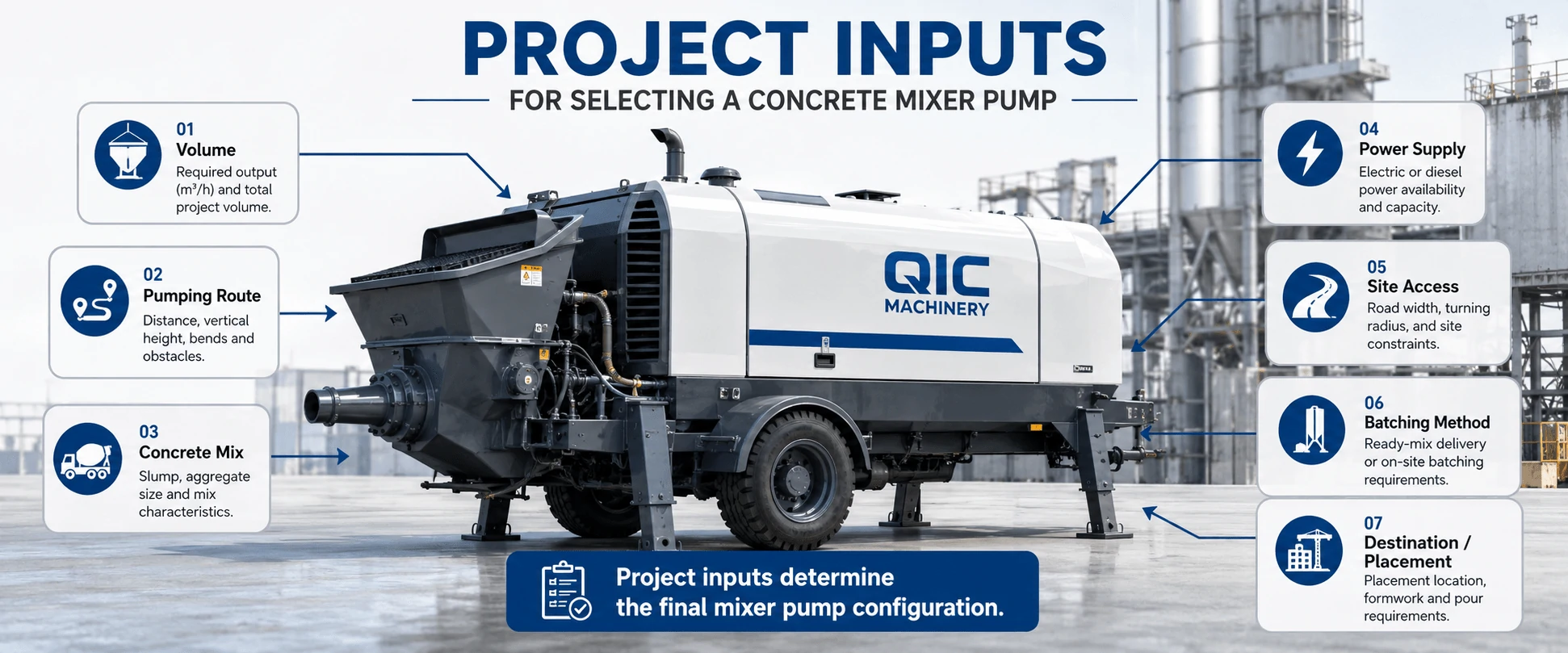
Tell us how many cubic metres must be placed, how many working hours are available, and how ingredients will enter the mixer. Those details show whether one mixer pump can maintain the required pace.
When a Concrete Mixer Pump Fits Better Than Separate Equipment
Choose an integrated mixer pump when concrete must be prepared near several modest pours and a compact setup can complete the work within the available shift. Choose a separate pump when ready-mix concrete already arrives reliably, because an additional mixer would duplicate work and cleaning.
| Site condition | Equipment to consider | Why the choice changes | Consequence of the wrong choice |
|---|---|---|---|
| Materials are stored beside modest or scattered pours | Concrete mixer pump | One machine mixes beside the pour and feeds the pipeline directly | Separate machines add another handoff, more space, and more coordination |
| Ready-mix trucks already provide a steady concrete supply | Trailer pump or boom pump | The site needs placement capacity, not another mixer | An integrated mixer adds idle equipment and cleaning work |
| Concrete must move between several discharge points without pressure pumping | Self-loading concrete mixer | Mobile mixing and transport matter more than a fixed pipe | A pipeline machine restricts where the concrete can be discharged |
| Several recipes or a major continuous pour are required | Batching plant plus a separate pump | Controlled weighing and continuous supply become more important than compactness | A small integrated mixer can interrupt the pour while each batch is prepared |
A truck-mounted mixer pump is a separate option for frequent road movement. Before choosing it, confirm chassis registration, road limits, local maintenance access, and transport cost; otherwise the mobility advantage may create additional compliance and service work.

Draw the Pipe Layout Before Selecting Pressure and Output
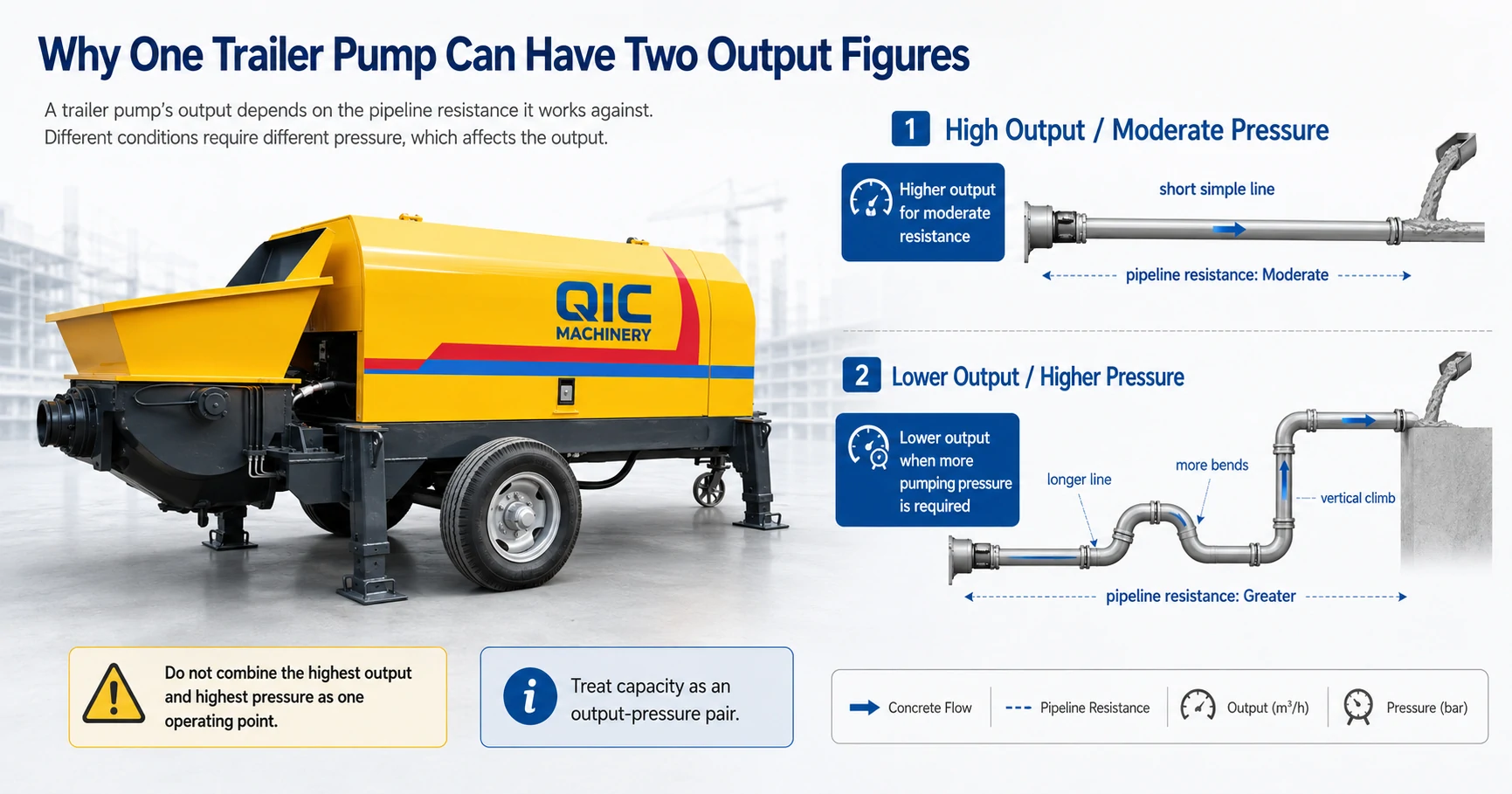
A long vertical rise and several bends increase pumping resistance. In that situation, pressure capacity and concrete consistency matter more than the headline hourly output; an output-led choice can leave the machine struggling with slow flow or repeated blockages.
Mark the horizontal pipe length, vertical rise, number of bends, end-hose length, and proposed pipe diameter. Add the concrete slump, maximum aggregate size, particle shape, grading, admixtures, and fibers. These details determine how easily the concrete passes through the mixer, valve, cylinders, and pipe.
| Changing condition | Selection change | Reason | Possible site problem |
|---|---|---|---|
| Vertical rise or bend count increases | Give greater weight to pressure, concrete pumpability, and pipe diameter | Each rise and bend adds resistance | Slow flow, pressure loss, or blockage |
| Aggregate becomes larger, angular, or poorly graded | Reconsider the valve, cylinder, screen, mixer, and pipe size | The concrete becomes harder to mix and pass through restrictions | Segregation, blocked pipes, and faster wear |
| The machine position moves farther from the pour | Add the actual pipe and bend quantities before pricing | A longer layout needs more components and creates more resistance | Missing pipe at startup or an unsuitable pump choice |
| Access becomes narrower or the ground becomes softer | Confirm machine dimensions, towing access, setup direction, and ground preparation | The machine and material supply must reach a stable working position | Unsafe positioning or extra material handling |
A phone sketch can provide enough information for the first calculation. Show the machine position, farthest discharge point, highest point, major bends, and pipe diameter; site photos can clarify road width, ground condition, and material access.
Choose Diesel or Electric Power from the Site Utilities
Choose diesel when stable industrial electricity is unavailable or the machine must move between temporary sites. Choose electric for a fixed site only after voltage, frequency, phase, transformer capacity, cable distance, and grounding are known; an undersized supply can cause trips, unstable operation, or motor damage.
Altitude, ambient temperature, fuel availability, emissions requirements, and maintenance access also matter for diesel equipment. Ignoring those conditions can reduce available power or make routine service difficult.
The mixer must support the same production pace. A drum mixer suits compact, standard small-batch work, while a forced or twin-shaft mixer may be considered when more intensive mixing is required. The second option also changes motor power, feeding, cleaning, and wear-part demand, so it should not be selected by mixer name alone.
Compare Manufacturers with the Same Machine and Included Items
Manufacturer names become useful only after each company prices the same machine and included items. Send the same concrete demand, pipe layout, power supply, pipe quantity, spare-parts list, destination, and startup requirements to every company; otherwise a lower total may simply contain less equipment.
This guide includes AIMIX, Daswell, HAMAC, LUTON, and QIC Machinery without assigning a quality or price rank.
| Company | Mixer-pump options currently listed | Details to request for your machine |
|---|---|---|
| AIMIX | Drum, vertical-shaft, and boom-integrated options | Exact model, mixer, engine or motor, pressure, pipe quantity, accessories, spare parts, freight terms, and startup work |
| Daswell | Drum and twin-shaft options, including EMP40 and DMP50 data | Continuous output for your feeding method, pipe calculation, component brands, included tools, and destination preparation |
| HAMAC | HBT25-L2 data and related electric, drum, and forced-mixer options | Current model, aggregate and slump limits, mixer method, functional tests, pipe package, and wear parts |
| LUTON | Mixer-pump model examples within its concrete-pump types | Dedicated model, complete equipment list, freight terms, startup responsibility, and warranty terms |
| QIC Machinery | Our three diesel and two electric models from 10 to 40 m³/h theoretical output | Your concrete demand, pipe layout, power, site access, required pipes, spare parts, packing, and destination |
A quotation should name the engine or motor, mixer, pump pressure, control and hydraulic components, pipe diameter and quantity, elbows, clamps, seals, end hose, cleaning tools, initial wear parts, packing method, freight terms, manuals, technician terms, and warranty exclusions. Missing lines usually reappear later as extra purchases or unclear responsibilities.
Use QIC Machinery Model Data as a Starting Range
Our current models cover 10–40 m³/h theoretical output, with three diesel and two electric options. Use the table to narrow the first candidates, then reduce or change the selection when the feeding rate, concrete mix, pipe resistance, power supply, or available space cannot support the listed value.
| Model | Power | Theoretical output | Pressure | Vertical / horizontal reference | Rated power |
|---|---|---|---|---|---|
| JZB200-10R | Diesel | 10 m³/h | 10 MPa | 100 / 400 m | 16.2 + 13.2 kW |
| JBT30-10-56R | Diesel | 30 m³/h | 10 MPa | 120 / 300 m | 56 kW |
| JBT40-11-82R | Diesel | 40 m³/h | 11 MPa | 120 / 500 m | 82 kW |
| JBT30-6 | Electric | 30 m³/h | 6 MPa | 120 / 300 m | 42 kW pumping motor |
| JBT40-11 | Electric | 40 m³/h | 11 MPa | 80 / 250 m | 45 kW pumping motor |
The distance figures are technical references, not guaranteed results for every pipe layout. More bends, a greater rise, a smaller pipe, difficult aggregate, an unsuitable slump, high temperature, or worn components can reduce practical distance and output.

What the Myanmar and Vietnam Cases Tell You
Our Myanmar HBT30 case includes one HBT30 concrete mixing pump, an 18.5 kW power reference, and equipment and shipment images. Our Vietnam 30M3 case includes one 30M3 concrete mixer pump, a 37 kW power reference, and factory, loading, and project material.
These details show the supplied equipment and the documented stage of each case. They do not state the concrete mix, pipe length, vertical rise, sustained output, or maintenance history, so those results should not be assumed for another site.
For your order, ask us to identify the current machine by model and serial number, show the included components and functional tests, and list the pipes, accessories, spare parts, packing, manuals, and startup responsibilities in the quotation.
Why Two Mixer Pump Prices Can Be Different
Two prices can describe different machines even when the output label looks similar. A larger mixer, higher pressure, different engine or motor, longer pipe package, additional spare parts, export packing, freight, and technician work can all change the total.
| Item | What must be written | If it is omitted |
|---|---|---|
| Machine | Model, mixer, pressure, engine or motor, hydraulic and control components | Unlike machines appear to have the same price |
| Pipes and tools | Diameter, straight pipe quantity, elbows, clamps, seals, end hose, and cleaning tools | Essential items must be purchased before startup |
| Wear parts | Part names, part numbers, and initial quantities | Maintenance stock is unknown when wear begins |
| Destination preparation | Voltage or engine specification, labels, guarding, documents, and packing | Adaptation work moves to the jobsite |
| Freight terms | Incoterm, inland transport, ocean freight, insurance, tax, duty, and transfer point | The final landed cost cannot be compared |
| Startup work | Manuals, remote guidance, technician travel, training, warranty terms, and contact method | Responsibilities remain unclear when the machine arrives |
Send These Details Before Requesting a Quotation
Send the same project details to every manufacturer: required concrete volume per hour and per shift, concrete class, slump, aggregate type and maximum size, horizontal pipe length, vertical rise, bends, pipe diameter, power supply, road width, machine position, feeding method, destination, and required startup date.
After receiving them, our engineers can calculate the required work pace, narrow the diesel or electric model choice, estimate the straight pipes and bends, and list the accessories, initial wear parts, packing, manuals, and startup responsibilities. You receive a proposal that can be compared line by line rather than a single machine price.
Conclusion: Select the Complete Work Cycle
A concrete mixer pump in China is suitable when feeding, mixing, hopper transfer, and pumping can maintain the concrete pace required by your pour. If ready-mix supply is already stable or the required production exceeds a compact mixing cycle, a separate pump or a batching plant plus pump can avoid repeated waiting between batches.
Before choosing a manufacturer, put the model, mixer, pressure, engine or motor, pipes, accessories, spare parts, packing, freight terms, startup work, and warranty terms on one list. Send us the site and concrete details above if you want our engineers to narrow the model and calculate the pipe and accessory quantities.
Ask for a model and pipe calculation
Send us your hourly and shift demand, concrete mix, horizontal pipe length, vertical rise, bends, power supply, access, and destination. Our engineers can narrow the model and list the pipes, accessories, and initial wear parts.
Contact us with your site details.